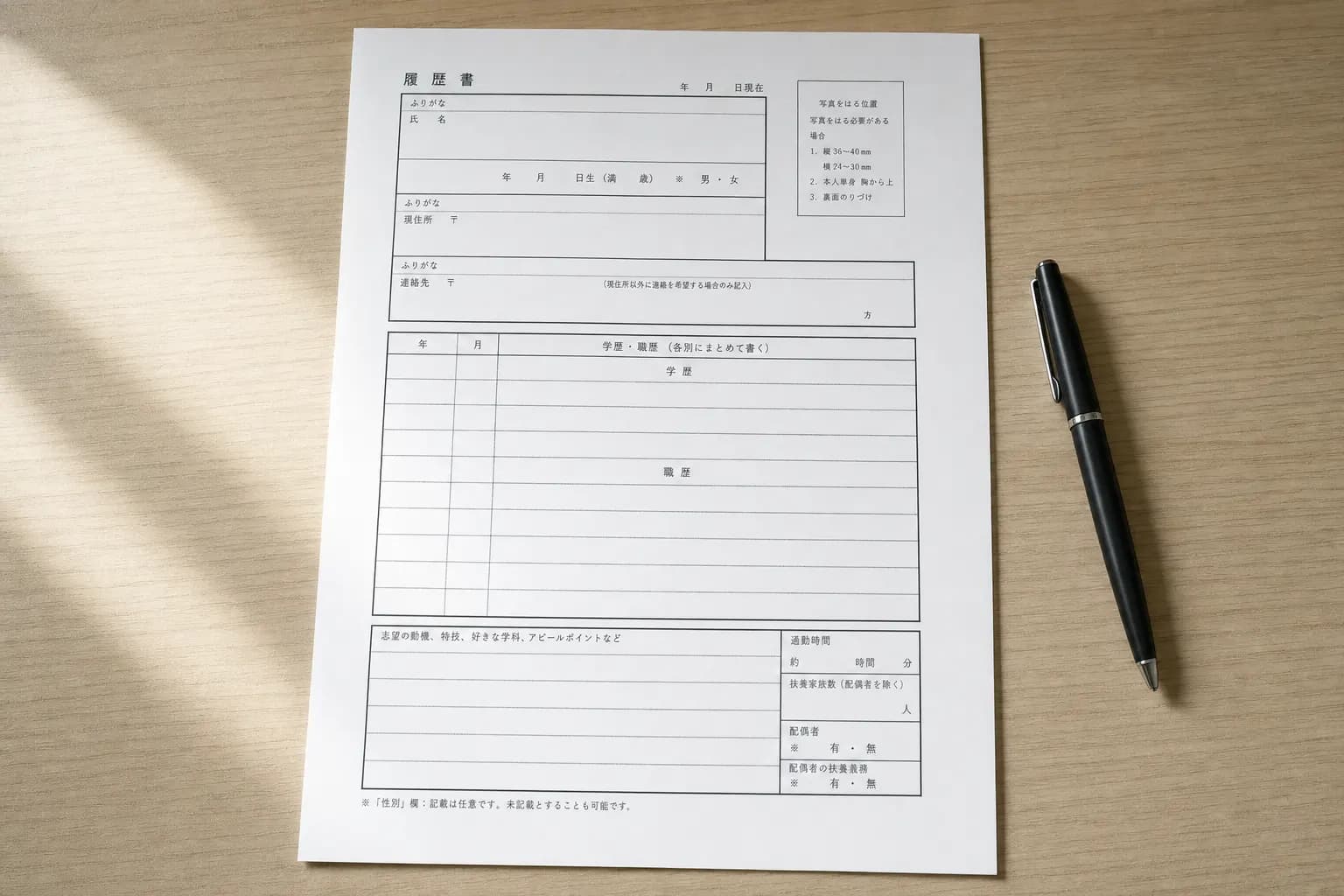
A 履歴書 (rirekisho) is Japan's standardized personal-history form. For almost every application you send it with a 職務経歴書 (shokumu keirekisho), the free-form work-history document.
The 履歴書 is not a Western CV in a Japanese font. It is a fixed layout that confirms who you are. Recruiters use it for first screening, then read the 職務経歴書 to see what you can actually do.
Do you need a 履歴書, a 職務経歴書, or both?
Usually both. Traditional companies and mid-to-senior roles almost always ask for both. Some startups and foreign-affiliated firms accept a 職務経歴書 only. Preparing both is the safe default, because you can drop the 履歴書 later more easily than you can invent one the night before.
| 履歴書 (rirekisho) | 職務経歴書 (shokumu keirekisho) | |
|---|---|---|
| Purpose | Who you are, for first screening | What you can actually do |
| Format | Fixed template | Free-form |
| Photo | Required, 40 × 30 mm | Not needed |
| Length | 1-2 pages | 1-3 pages, by career length |
| Who asks | Almost every employer | Most employers; some startups only this |
If you only have time for one document tonight, start with the 履歴書. It is the form that rejects you for a missing photo or a date written two ways.
What goes in a 履歴書
A rirekisho is filled top to bottom. The 2021 JIS revision dropped the 押印 (hanko stamp) field, made gender optional, and removed the old commute-time and dependents rows. If an English blog still tells you to stamp the page, it is describing the old form.
- 基本情報 (basic information): name with ふりがな (furigana), date of birth, address, contact, and the photo.
- 学歴・職歴 (education and work history): chronological. Each school you entered and graduated, then each job you joined and left.
- 免許・資格 (licenses and qualifications): official names, in the order you earned them. JLPT belongs here.
- 志望動機・自己PR (motivation and self-PR): why this company, plus a strength with evidence. Rewrite both for each application.
- 本人希望記入欄 (requests): normally 「貴社の規定に従います」 (I will follow the company’s terms) unless you have a genuine must-have.
The rules foreigners get wrong
These are the details that make a first screen look careless.
- Photo: 縦40 × 横30 mm, portrait, business attire, taken within 3 months. Many English guides say six months. Japanese guidance is three, so the photo matches how you look now.
- Date: the date on the form is the day you send it, not the day you created the file.
- 西暦 or 和暦: Western years (2026) or era years (令和8) are both fine. Pick one and keep it through birth date, schools, and jobs.
- Your name: add ふりがな or カタカナ so someone can say it aloud without guessing.
- Hanko: you generally do not need a personal seal on the modern form. A few traditional employers still expect one. The standard 2021 layout has no stamp box.
Before you send:
- Photo is 40 × 30 mm, taken within 3 months, business attire
- Dates use one system all the way through
- Name has ふりがな or カタカナ
- 志望動機 and 自己PR are rewritten for this company
- 本人希望記入欄 is 「貴社の規定に従います」 unless you have a real condition
Handwritten or digital?
Digital is fine and now standard. A clean typed rirekisho with correct formatting reads as more professional than a rushed handwritten one, and you can reuse it.
If a posting still asks for 手書き (handwritten), follow that posting. Do not treat it as the default in 2026.
Common questions
Can I send my English CV instead?
Not for a Japanese employer that asked for 履歴書. An English CV can sit behind a 職務経歴書 at some foreign-affiliated firms. If the posting names 履歴書, send the form.
Do I need a hanko?
Not on the 2021 layout. Skip it unless that employer’s instructions say otherwise.
What size is the photo, exactly?
40 mm tall by 30 mm wide, portrait, taken within 3 months. Not square. Not a passport crop that you guess is close enough.
Build yours on NihonResume
You do not have to draw this layout by hand. Convert an existing CV into a 履歴書, or start from a template. Then ask NihonResume AI to rewrite 志望動機 and 自己PR for the company in front of you.
Next: pick the right template for your role, or build your first resume.